
Interview prep
How to Explain Technical Tradeoffs Clearly in an Interview
Use a four-part structure to explain your decision, compare alternatives, name the cost you accept, and show what would make you reconsider.
October 25, 2026 · 6 min read

Summary slide. Tie your choice to a constraint, compare a credible alternative, and say what would make you reconsider. Artwork is AI-generated; every word on the slide comes from this article. Save the slide (PNG)
To explain a technical tradeoff in an interview, state your decision, compare credible options, name the cost you accept, and explain what would make you reconsider. Tie the choice to the problem’s constraints, not a universal best practice.
If you are getting interviews but not offers, communication is one possible area to investigate, not a diagnosis. Check whether your answers reveal your reasoning or merely name a plausible solution.
Give a recommendation, not a tour of everything you know
Thinking out loud does not require narrating every thought. Make the decision easy to examine: what you prioritized, what you sacrificed, and where your recommendation stops being appropriate.
Use this speaking card:
Decision: Given [important constraint], I would choose [approach].
Options: The credible alternative is [alternative]. It is better at [benefit], but less suitable here because [reason].
Accepted cost: My choice gives up [benefit] or introduces [burden]. I would manage that by [mitigation].
Reconsideration: I would revisit the choice if [assumption changes or observable evidence appears].
The accepted cost matters. “It adds complexity” says less than “It introduces a background worker whose failures we must detect and recover from.” Name the work your decision creates.
Mitigation does not erase the tradeoff. Retries can help with transient failures, but you still need to handle duplicate execution, retry limits, and jobs that ultimately fail.
Worked example: generating a downloadable report
Hypothetical interview scenario: You are designing a reporting feature. Assume reports vary substantially in size, users can return later to download them, and the product must show whether a report is pending, complete, or failed. You have no measurements of execution time or traffic.
A solution-only answer might be:
“I would put report generation on a queue because that scales better.”
That names a mechanism, not a reason. A queue can separate request handling from background work and buffer jobs, but it does not create processing capacity. Completion time still depends on demand and worker capacity.
Here is a provisional recommendation using the speaking card:
Decision: “Given that users can return later and report size varies, I would make report generation asynchronous. The request would create a durable job and return an identifier so the user can check its status.”
Options: “The simpler alternative is to generate the report during the request. That avoids a separate worker and a pending state in the interface. Larger reports could keep requests open longer than we want, but I would measure representative runtimes before treating that concern as established.”
Accepted cost: “The asynchronous design adds delayed completion, job-state management, and failure recovery. I would make repeated execution safe for the same job identifier and expose a failed state rather than leave users waiting indefinitely. Those measures still leave another processing path to operate.”
Reconsideration: “I would revisit this if measurements showed that reports consistently finish within the agreed request-time budget and synchronous processing meets expected demand. Then the additional machinery might not be justified.”
The reasoning connects the requirement, the alternative, and the cost. It also separates an assumption from a measurement. You can recommend a design without pretending to know the workload.
Make “how I would know it was wrong” observable
Avoid ending with “we would monitor it.” Say what evidence matters and how it would affect the decision.
| Evidence to examine | What it would tell you | |---|---| | Representative report runtimes | Whether synchronous execution could fit the agreed request-time budget | | Job waiting time and completion time | Whether the background system meets the user’s waiting-time requirement | | Repeated execution producing inconsistent output | Whether duplicate handling is inadequate | | Users needing the result before they can continue | Whether the asynchronous interaction fits the actual workflow |
Not every signal calls for a new architecture. A growing backlog might call for more processing capacity or admission control. A workflow that requires an immediate result challenges the interaction model itself.
Respond to challenges by updating the reasoning
If the interviewer changes a constraint, check whether it changes the tradeoff. You do not need to defend your first choice.
“If users must receive the report before continuing, my assumption about acceptable waiting no longer holds. I would clarify whether they need the full report or a smaller immediate result, then assess whether that output can reliably fit within the request-time budget.”
That is an update, not a retreat. You are showing which requirements your recommendation depends on.
Practice the missing sentence, not another entire design
Choose a technical decision from a mock interview or a project you can discuss without confidential details. Record an answer using the speaking card, then check:
- Did I identify the constraint that drove the choice?
- Did I give the alternative a genuine advantage?
- Did I name a specific cost instead of saying “complexity”?
- Did I distinguish assumptions from known facts?
- Did I say what evidence would change my recommendation?
Ask a practice partner to change one important constraint. Revise your answer without restarting the whole design.
If the missing piece is an accepted cost or a reason to reconsider, practice that sentence. You may not need another entire design exercise.
For support with that preparation, explore interview coaching from Skills Tech.
Save the field guide
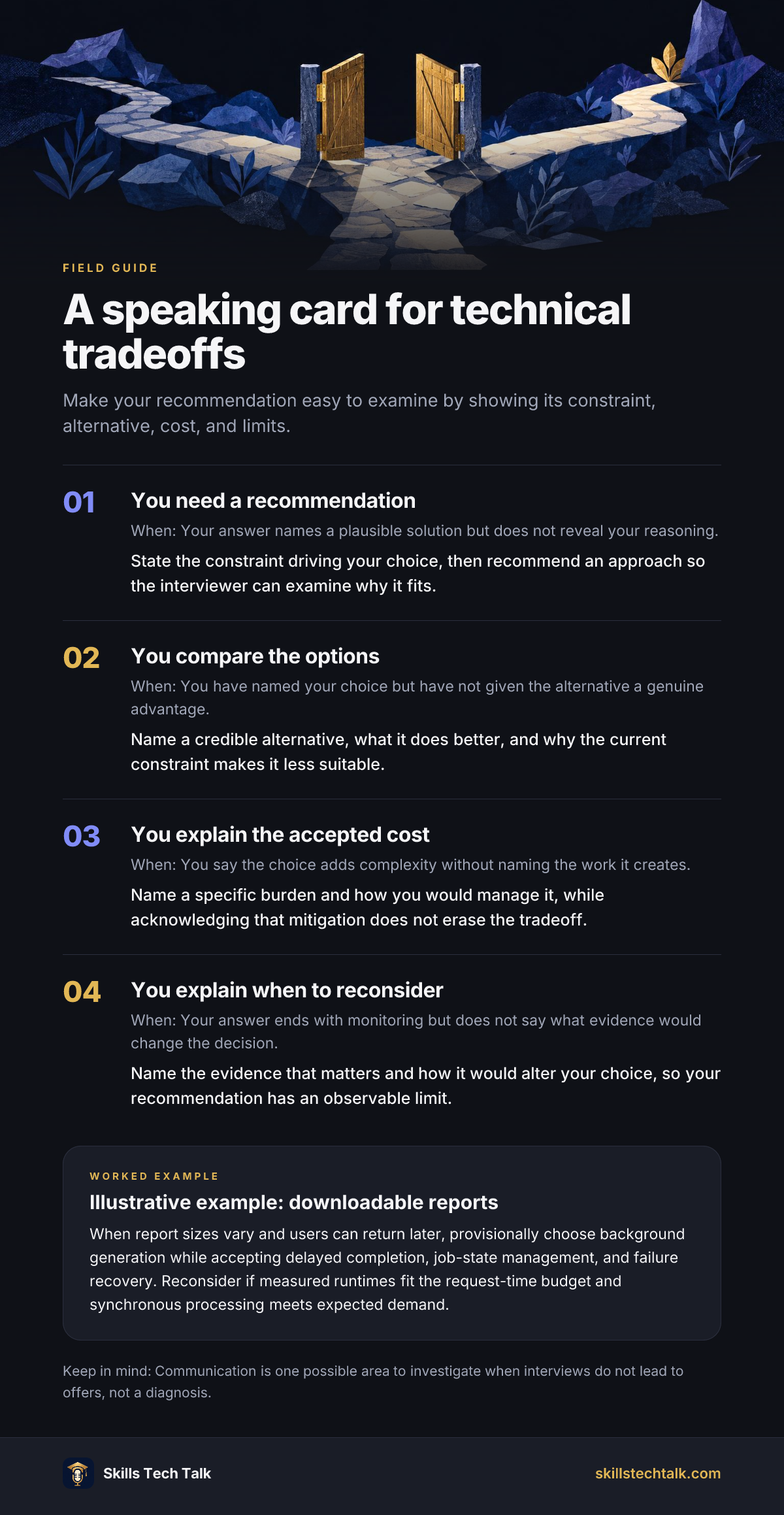
A field guide distilled from this article. The text version follows below.
Text version
- You need a recommendation: Your answer names a plausible solution but does not reveal your reasoning. State the constraint driving your choice, then recommend an approach so the interviewer can examine why it fits.
- You compare the options: You have named your choice but have not given the alternative a genuine advantage. Name a credible alternative, what it does better, and why the current constraint makes it less suitable.
- You explain the accepted cost: You say the choice adds complexity without naming the work it creates. Name a specific burden and how you would manage it, while acknowledging that mitigation does not erase the tradeoff.
- You explain when to reconsider: Your answer ends with monitoring but does not say what evidence would change the decision. Name the evidence that matters and how it would alter your choice, so your recommendation has an observable limit.
Illustrative example: downloadable reports: When report sizes vary and users can return later, provisionally choose background generation while accepting delayed completion, job-state management, and failure recovery. Reconsider if measured runtimes fit the request-time budget and synchronous processing meets expected demand.
Communication is one possible area to investigate when interviews do not lead to offers, not a diagnosis.